Questions of Faith, Part V
Today, Jim turns our attentions back to the Earth-honoring traditions... but remember that the door is still open for discussion of previous posts as well.

Shaman at work
What faith do you espouse?
Er...many of them? I've worn the title Shama-Wicca-Paga-Druid, though
most of my recent instruction has been in Curanderismo, or Peruvian
Shamanism. I am continually examining aspects of Earth-honoring
traditions and blending them into my own spiritual practice.
Who was the founder of your faith? When did he/she live?
Like so many of the Earth-honoring traditions, there isn't a single
founder, at least not in recorded history. Most of them are quite
ancient, tracing back centuries or even millennia. From the Celts to
the Mayan Civilization, it's been around.
What are the sacred texts of your faith?
Most of the traditions I have studied and incorporated into my spiritual
practice do not have sacred texts like the Bible or Koran. They were
primarily oral traditions, handed down from one generation to the next.
As Zeus talked about in his discussion of Druidism, many traditions had
written materials and relics destroyed as Christianity became
more...active...in its spread. Many of my teachers to date have
maintained those traditions and ways, though there are many reference
books and printed resources now available for those interested.
What is the central teaching of your faith?
Most of my practice revolves around the concept that all things are
alive and connected to one another. Respecting that connection is
paramount, and being cognizant of it, the goal. There are energies that
flow in paths through the Earth, that bind human beings within the
natural realms, and that move between different worlds and realities.
Some of these energies can be harnessed or focused for direct purpose,
though "power" is not the focus; it's about healing. There is a
logical order to this, described well by a Native American healer.
First, we heal ourselves. Then our families. Then our community. Then
the world. Unless we are complete and focused ourselves, we're not of
much use to others.
How does your faith define sin? What are the major sins, and how is one
absolved?
Sin isn't exactly the right terminology here. Things are usually right
or wrong, but the concept of sin would be an imposed construct here.
The closest I can come would be "harming others." As Zeus described,
one of my tenets is "And it harm none, do what ye will." Shamans are
focused on the highest good, both for an individual and for Pachamama
(Mother Earth). We do deal with jucha (pronounced hoo-cha), or dense
energy. This is typically picked up thanks to negativity, either our
own or from those around us. This can be ceremonially or ritually
cleansed. Sometimes we can cleanse ourselves; sometimes we need the
help of others.
Roughly how many adherents does your faith have?
Answer 1) Lots. Yes, that's the technical term. This is just too
difficult to calculate, as there are so many people who could be
solitary practitioners. The number is growing, I do know that.
Answer 2) One. Me. Part of what works best for me is that I can determine my
own practice. I am combining aspects of several like-minded traditions.
Some have prescribed ceremonies or rituals. Some are much less
structured. So in a way, my practice is entirely unique, though I
believe it's directly connected to many other traditions.
What does your faith teach about the afterlife? Is there heaven, and how do you get there?
All of my traditions agree that there is something beyond death, and
that there is a spiritual realm one can access. It's based on the idea
that we are all composed of energy, and that energy never dies. We
simply transmute, transform, or otherwise cross over. Those barriers
are not absolute, and to me, allows for the existence of ESP, ghosts,
demons, etc...all phenomena in which I believe. Many of my traditions
also believe in reincarnation.
What are the practices of your faith? (Daily, weekly, etc.)
It's much more based on "as needed," though the Shamans I work with
"link up" spiritually every Wednesday night. There are regular
gatherings and observances of new/full moons, solstices/equinoxes, and
various holidays. Personally, I try to meditate or commune at least
daily.
How is your faith organized? Are there priests and bishops and
archbishops, etc...?
There isn't a clearly defined hierarchy, to be sure. There are some who
are considered leaders, though their power or influence is not absolute.
They're the first people to admit they will make mistakes and are
imperfect. We believe that we are all teachers, and all students. Even
someone with no "training" or experience can impart great wisdom.
Are there regular services available to you locally? If so, where?
A group of us gather regularly. For more information, email me and I'll
hook you up with the leader of our local allyu (Circle/Family).
How did you come to be a believer?
I'm a recovering Lutheran. Christianity never seemed to resonate within
me. It also dismissed or ignored many things I have either witnessed or
believe in (ESP, ghosts, etc). The more I studied Earth-honoring
traditions, the more it seemed to fit. When a close friend of mine
began her path, I followed along not far behind.
What do you wish others knew about your faith?
It's not about casting spells, making sacrifices, or obtaining power.
It's not about sorcery, Merlin, or turning lead into gold. It's about
being a good person, honoring all life around us, and working toward a
more peaceful and harmonious existence.
----------------------------------------------------------------------------
As usual, comments can be posted here or on his blog. If your question is of a more personal nature, feel free to Email me at the address on my profile and I'll forward them on to him.


Sunday Sermon

"Skippy stared blankly as Tessa explained Transubstantiation..."
Questions of Faith, Part IV
The Religious experience is diverse, even amongst followers of the same Faith. Today, Tessa gives us a different slant on Catholicism...
------------------------------------------------------------------------
What faith do you espouse?
I am Roman Catholic, and though I love my Church I have issues with
some of the teachings. I remain Catholic because I believe that the
best way to effect change is from within.
Who was the founder of your faith? When did he/she live?
To the best of my historical knowledge, a man called Jesus of Nazareth was alive from around the year 4 BCE to the year 30 CE. His message was not "hey, I have this great new church" - that came later. He did seem to think that love was a good idea though.
What are the sacred texts of your faith?
There are several texts that the Catholic Church considers sacred. The most obvious would be the Bible, with an emphasis on the New Testament, where we find the stories of Jesus, and the letters establishing the meaning and way of life for Christians in the early Church. There are also the writings of the saints and the Episcopal Letters from various popes and bishops, addressing key issues in the world at the time when they were written.
What is the central teaching of your faith?
The central teaching can be found in the creed that we profess:
"We believe in one God,
the Father, the Almighty,
of all that is, seen and unseen.
We believe in one Lord, Jesus Christ,
the only Son of God,
eternally begotten of the Father,
God from God, Light from Light,
true God from true God,
begotten, not made,
of one Being with the Father.
Through him all things were made.
For us and for our salvation
he came down from heaven:
by the power of the Holy Spirit
he became incarnate from the Virgin Mary,
and was made man.
For our sake he was crucified under Pontius Pilate;
he suffered death and was buried.
On the third day he rose again
in accordance with the Scriptures;
he ascended into heaven
and is seated at the right hand of the Father.
He will come again in glory to judge the living and the dead,
and his kingdom will have no end.
We believe in the Holy Spirit, the Lord, the giver of life,
who proceeds from the Father and the Son.
With the Father and the Son he is worshipped and glorified.
He has spoken through the Prophets.
We believe in one holy catholic and apostolic Church.
We acknowledge one baptism for the forgiveness of sins.
We look for the resurrection of the dead,
and the life of the world to come. Amen. "
This is the creed that was decided on initially at the Council of
Nicaea in 325. There was one line added later, "and the Son" which I
italicized and though philosophically the same, this insertion is one
of the primary acts that led to the split of the Western and Eastern
Rite Churches. The creed covers creation, the Trinity, the virgin
birth, and apostolic succession, and that is the core of what we believe.
The only primary belief that is not in some way mentioned in this
creed is the Eucharist (which actually falls under the auspices of
apostolic succession). That is our belief that the bread and wine
actually become the Body and Blood of Christ. This is tricky for a
couple reasons; first, if this were a physical actuality that would
just be icky. This is a spiritual process called transubstantiation,
and basically means we believe that though all we are able to perceive is the bread and wine, the Body and Blood are also present, not just represented.
How does your faith define sin? What are the major sins, and how is one absolved?
Catechism Definition: Sin is an utterance, a deed, or a desire
contrary to the eternal law (St. Augustine). It is an Offence against
God. It is an act contrary to reason. It wounds man's nature and
injures human solidarity. The kinds and the gravity of sins are
determined by the object. To choose deliberately - knowingly and
willingly - something gravely contrary to the divine law and the ultimate end of man is a mortal sin (the eternal death kind). A moral disorder that is reparable by charity is a venial sin.
I would agree that a sin is an offense against reason, truth and right
conscience - to sin you have to knowingly and willingly commit that offense. Everyone's conscience is informed to a different degree and in a different manner, and each case is specific unto itself, but as general broad definitions go, I guess that one is ok.
Absolution is a bit more complicated. This is one of the things that I
had a hard time coming to terms with, and I continue to struggle with
it. The Catholic Church teaches that Jesus gave authority to the
apostles to forgive sins, and that authority has passed down through
the priesthood. The process happens through the Sacrament of
Reconciliation. I don't believe that the only way sins can be
forgiven is through reconciliation (even mortal sins, which is a point
of difference from the Church). The value of the sacrament comes not from the list of sins I rattle of to the priest. God knows them and has already forgiven me. The value is in the vocalization of forgiveness. The words "I absolve you" are very powerful both spiritually and psychologically. That is what is important about
Reconciliation. It helps me to forgive myself and to work towards reconciling with those whom I have hurt.
Roughly how many adherents does your faith have?
1,050,000,000 according to adherents.com. I don't know them all either...
What does your faith teach about the afterlife? Is there heaven,
and how do you get there?
Catechism Definition: Heaven is the ultimate end and fulfillment of the deepest human longings, the state of supreme, definite happiness, where we are all like God forever. The choices you make in this life effect whether you will see God in the next one. It is a state of being in perfect union with God.
There are lots of images given and speculation done, but it is ultimately a mystery until we die. I believe that we live out our afterlife now. Every moment we either live closer to God or farther away. The only moment you have is the present one and how you live it is what matters. Because "heaven" is a state of being, you can be there whenever you wish.
What are the practices of your faith? (Daily, weekly, etc.)
Holy days of obligation:
1) January 1, the solemnity of Mary, Mother of God
2) Thursday of the Sixth Week of Easter, the solemnity of the Ascension
3) August 15, the solemnity of the Assumption of the Blessed Virgin Mary
4) November 1, the solemnity of All Saints
5) December 8, the solemnity of the Immaculate Conception
6) December 25, the solemnity of the Nativity of Our Lord Jesus Christ
[list numbers are not in original]
Whenever January 1, the solemnity of Mary, Mother of God, or August 15, the solemnity of the Assumption, or November 1, the solemnity of All Saints, falls on a Saturday or on a Monday, the precept to attend Mass is abrogated. (Code of Canon Law)
Catholics are also supposed to attend Mass on Sundays and of course on Easter.
Devotions beyond that are according to your personal practices and beliefs.
How is your faith organized? Are there priests and bishops and
archbishops (oh my!)?
There are deacons, priests, bishops, archbishops, and cardinals all
organized hierarchically under the authority of the Pope. Currently,
all of those ordained ministers must be men. Interesting fact - all
Catholics are baptized prophet, priest, and king. Makes the debate on women priests slightly more heated.
Are there regular services available to you locally? If so, where?
I go to the Newman Center Catholic Parish. There is also St.
Laurence, for the more traditionally minded.
How did you come to be a believer?
I am what is affectionately (or not so) referred to as a "Cradle
Catholic" I was raised Catholic (read: forced to go to church and
other various activities until I left for college). At school though, I
started evaluating my faith and learning more than the answers that
had been fed to me all my life. I am still searching, but have come
to terms with my faith and will continue to struggle and grow.
What do you wish others knew about your faith?
We don't worship Mary. We don't believe that everyone but us is going to hell. I don't always agree with everything we are supposed to believe.
--------------------------------------------------------------------
As usual, feel free to make comments here; if you have a more private message, send them to the Email address on my profile and I'll forward them on to her.
Questions of Faith, Part III
In the place of the Sunday Sermon, our next guest blogger, Rachel, gives us the scoop on Baha'i.
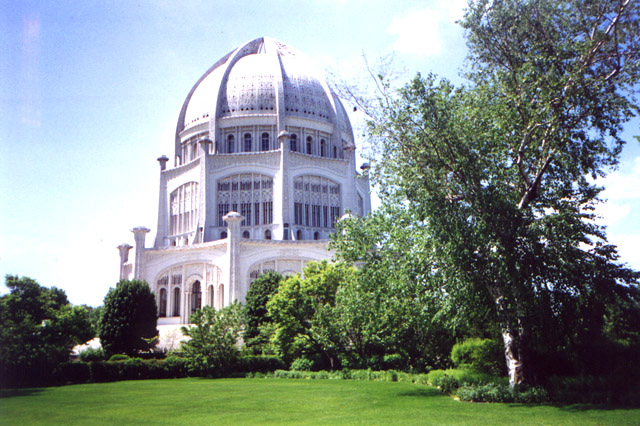
Baha'i House of Worship in Illinois
What faith do you espouse?
The Baha’i Faith
Who was the founder of your faith? When did he/she live?
Baha’u’llah, the founder of the Baha’i Faith, was born in Persia in 1817. His ministry lasted from 1863 to 1892, during which He was banished from Persia, then from Constantinople to Adrianople, and eventually to Akka.
What are the sacred texts of your faith?
Baha’u’llah revealed somewhere in the neighborhood of 2 million verses. The Most Holy Book, the Kitab’I’Aqdas, is the Book of Laws. Other significant texts include the Kitab’I’Iqan, the Hidden Words, and a collection of Tablets written to the rulers of the world. As you can imagine, however, the list goes on and on.
What is the central teaching of your faith?
Baha’u’llah emphasized unity. He taught that all people are created noble and therefore all prejudices of race, gender, socio-economic status, and so on are unfounded and must be overcome through love and understanding. Also central to this unity is the concept of “progressive revelation.” Basically, we believe that God has been providing mankind with guidance from the beginning, through various religious/spiritual Teachers, including but not limited to, Jesus Christ, Muhammed, Buddha, Abraham, Krishna, and Moses. A good metaphor for this is school. Each year students have a different teacher who applies social rules appropriate to the needs of that age, but continues to build on the universal lessons of math, literacy, and science. With each new grade level, the students’ understanding of these topics deepens just as humanity’s ability to understand their spirituality grows with each Divine Teacher, though the social practices of their religions differ.
How does your faith define sin? What are the major sins, and how is one absolved?
Sin is very simply not obeying the laws of God, which for Baha’is are outlined in the above mentioned Book of Laws. There are the basics like don’t kill, steal, or adulter, but the most serious sin is backbiting, that is, saying bad things about others, regardless of whether it is true. The absolution of sin comes largely from praying for forgiveness and amending one’s behavior. However, for certain transgressions there are specific penances that go along with prayers for forgiveness. Adultery, for example, is punishable with a hefty fine which doubles with each repeat occurrence.
Roughly how many adherents does your faith have?
Somewhere shy of 7 million. It’s pretty small for being the second widest spread religion in the world.
What does your faith teach about the afterlife? Is there heaven, and how do you get there?
A friend once described us as spiritual beings having a physical experience rather than physical beings having a spiritual experience. Baha’u’llah wrote,
“Know thou of a truth that the soul, after its separation from the body, will continue to progress until it attaineth the presence of God, in a state and condition which neither the revolution of ages and centuries, nor the changes and chances of this world, can alter. It will endure as long as the Kingdom of God, His sovereignty, His dominion and power will endure. It will manifest the signs of God and His attributes, and will reveal His loving kindness and bounty.”
The concept of heaven and hell comes into play in the discussion of nearness to God. We do no believe that there is a bad place where certain souls are sent for all eternity. Everyone progresses. However, the purpose of this life is to strengthen the attributes of the soul which draw us nearer to God (i.e. trustworthiness, honesty, love, kindness, humility, forgiveness, respect, justice etc.) which is heavenly joy. If we turn our back on God in this life than we are farther from God in the next, which is a misery that can be likened to hell and which makes the progress towards God more difficult.
Note: God is best described as “the Unknowable Essence” and the human soul is immaterial, therefore the description of nearness is metaphysical and not subject to physical distance.
What are the practices of your faith? (Daily, weekly, etc.)
On a daily basis Baha’is pray and reflect on the words of Baha’u’llah morning and evening, recite one of three obligatory prayers, and repeat the phrase “Allah’u’Abha,” meaning “God is Most Glorious,” 95 times. We attend the 19 Day Feast every, well, 19 days which is a time for Baha’is to come together, read the Writings, consult about community issues, and socialize. We also fast for 19 days in the spring (sunrise to sunset), and observe nine holy days each year. We go on pilgrimage, at least once in our lifetime, if we can afford it, to the Shrines in Israel. Lastly, we pay the Huququ’llah, 19 percent from inheritances or excess income, which will later be used for the welfare of those who are in need.
How is your faith organized? Are there priests and bishops and
archbishops, etc…?
There is no clergy. Instead we have elected bodies that govern and guide the communities. Each local community with 9 or more adult Baha’is has a Spiritual Assembly that is elected each year from the community. That group can then consult on matters of concern for individuals or the community, plan events, and give support to individual activities. There are National Spiritual Assemblies in most countries which perform the same function on the national scale, and to whom the local assemblies turn for guidance or assistance. And finally there is the Universal House of Justice which is elected every five years and provides the guidance and united force for the Baha’i communities around the world. Though members of any of these bodies are elected for their moral character, they have no authority or special station as individuals within the community (i.e. a member of the Universal House of Justice has no more authority than I do, though I suspect they have more wisdom, unless they are acting as a part of that institution).
Another interesting aspect of the Faith is the two figures who guided the Faith after the ascension of Baha’u’llah. In His will, Baha’u’llah specified that His son, Abdu’l-Baha was to act as the Center of the Covenant. He had the exclusive right to interpret Baha’u’llah’s writings. When he passed away, his will designated his grandson, Shoghi Effendi, as the Guardian, who then took over the responsibility of interpreting Baha’u’llah’s writings. Individual Baha’is have the right and responsibility to determine how Baha’u’llah’s teachings apply to their own lives, and can thus interpret meaning for themselves, however, only the Shoghi Effendi and Abdu’l-Baha could make authoritative interpretations. The writings of both of these men remain as sources of further wisdom and explanation. This precaution has guarded the Baha’i Faith from splintering under clashes of individual opinion.
Are there regular services available to you locally? If so, where?
Because our community is small we hold Feast, Devotions, Holy Day observance and other Baha’i events in the homes of community members. We do have regular dinners and devotions which are open to anyone who cares to come. Larger communities frequently have centers for these events.
How did you come to be a believer?
I was raised a Baha’i. I always agreed with the social tenets of the Faith. But I didn’t really become a Baha’i until I was 14 and I began to look at other religions. I went to various churches with friends, meditated at a Buddhist center, celebrated Passover and Solstice, and read about Islam. I saw the value and truth in each one which led me back to the teachings of Baha’u’llah. As I studied the history of the Faith and read more independently, I became increasingly confident that being a Baha’i was right for me. .
What do you wish others knew about your faith?
I would just like for people to know about the Baha’i Faith. It is still a somewhat obscure religion in spite of its wide spread state and its continued efforts to promote justice and equality throughout the world. And while I’m at it, I guess I would like to clarify that the Baha’i Faith is not a sect of Islam, which is a common misconception due to its Persian origins.
--------------------------------------------------------------------------------
As always, feel free to direct your comments here or to her blog. More private messages can be sent to the Email on my profile and I will forward them on to her.
Go in Peace.
Mental Break
To give you a break from all the pondering that has been going on around here lately, today we are playing the Guess the Martyred Saints Game!*
Honestly, who doesn't enjoy a good martyring? Post your results in comments and amaze your friends with your knowledge of obscure Catholic history!
*For amusement purposes only - please, no wagering.
Questions of Faith, Part II.V
(Mark had longer responses to our questions than would fit in the comment window, so this post is a continuation of that discussion.)
-----------------------------------------------------------------------
Thanks for the comments and questions.
To reply to Zeus, bigotry is the same no matter where it is
encountered. When I encounter it I am usuaully filled with sadness
and anger, not because of that person or those people but rather
because of the ignorance that is found there. And I deal with it like
I deal with anything fear-based, I "smile upon it as if to wash a
stain from their mind" (from a poem of mine). And I do this more to
give myself peace and release from the fear that they hold that is so
potent. Most things I do, I do for personal peace.
And for Linus' question about the trinity... the trinity is found
everywhere that a dualistic nature cannot be applied. For example,
black and white, male/female, big/tall, etc... are all things
associated with what I call "the worldly realm", and the worldly realm
has one great property: all is neutral. Meaning, that a chair is
neither good nor bad until you apply a value upon it. But as for the
trinity, all truth is tunneled through that paradox.
Traditionally, it is named as the father, the son, and the holy
spirit. But that naming was more applicable when people understood
the symbolism behind said names. Since then they have been perverted to not mean anything at all. I see them as the seed, the fruit, and the life... the mind, body, and soul... the I AM, the I EXPERIENCE, and the I BEING...
It can best be understood as a learning experience. The father is the
knowledge or the I AM, the son (us) is the experience or testing of
said knowledge (because experience speaks more deeply to our soul than words can ever do), and then the holy spirit is the state of being, nirvana, and heaven that comes from knowing it and then experiencing it. The holy spirit is said to give wisdom, and wisdom comes from experience.
So the trinity is truly "catholic" or universal and applicable to anything.
Peace to all...
Mark
--------------------------------------------------------------------------
Feel free to continue this with comments here or on Mark's new blog, "Conversations with God".
We will be hearing from Rachel next... look for it on Sunday!
Questions of Faith, Part II
While the discussion on Druidism continues below (see the comments), our next guest blogger, Mark, gives us a look at his unique take on Catholicism.
---------------------------------------------------------
What faith do you espouse?
Catholicism
Who was the founder of your faith? When did he/she live?
Jesus of Nazareth is the inspiration for the
original church, but to say that he is the sole
founder may or may not be wholey accurate. It might
be better to say that it is the memory of Jesus that
founded the Roman Catholic Church.
What are the sacred texts of your faith?
The Hebrew scriptures and the "new testament" which
includes the gopsels, acts, and the letters; commonly known as the Bible.
What is the central teaching of your faith?
Of my own faith the central teaching is love. God
is love. And to love as God loves is to love without
conditions.
How does your faith define sin?
Separation from God (or love) by the influence of
fear. Once again this is my own perspective.
What are the major sins, and how is
one absolved?
There are specific "cardinal" sins, but only the
person who commits a sin can truely judge how majorly
that sin affects their life. And it is only them that
can reconcile or re-connect with God.
Roughly how many adherents does your faith have?
I am sure that "on the books" somewhere that there
is an exact number, but I could safely guess somewhere
over a hundred. (and I certain don't know them all)
What does your faith teach about the afterlife? Is
there a heaven, and how do you get there?
There is always some sort of class on it but it is
never very concrete. The closest definition that I
have received is that heaven is either now...here, or
nowhere. In other words, heaven is right now if you
choose to experience it.
What are the practices of your faith? (Daily,
weekly, etc.)
Daily personal prayer, the rosary, comtemplative
prayer (christian meditation) and weekly mass. Weekly
mass is the only major weekly obligation, however, and
the other areas of persoanl prayer are determined by
tradition and personal preference.
How is your faith organized? Are there priests and
bishops and archbishops, (oh my!) etc.?
It is extremely structured with the Pope at the
top and your local pastor at the grassroots.
Are there regular services available to you
locally? If so, where?
Yes, St. Paul's Newman Center is my choice.
How did you come to be a believer?
Life, loss, pain, joy, fear, and love in my
personal experience has shaped the path and life that I lead.
What do you wish others knew about your faith?I wish that others knew what real catholics are
like, not what the pope pushing, bigoted, and
super-traditional Catholics show to the world. The
word catholic means universal, liberal, and sensitive.
And that is the backbone of my faith.
Peace, love, and all good things...
Mark
-----------------------------------------------------------------
As always, you are welcome to make comments on this either here or on Mark's blog. If you would prefer to address Mark via Email, send your messages to the address listed in my profile and I will forward them on to him.
Questions of Faith
The first installment in our guest blogger series is Travis, AKA Zeus...
---------------------------------------------------------------------
What faith do you espouse?
My faith is to follow, as closely as possible, the teachings of the Druids. I realize this is vague, but hopefully it won’t be by the time I am done. Druid is an old Celtic word meaning – “OAK WISE.”
Disclaimer:
I am but one of many who follow this faith; I do not speak for all. There are too many diverse people and opinions represented by this faith to begin to do so. Further, I do not speak for the God or Goddess or any of their representative lower deities within this faith. I am not qualified to do so via this medium or on such broad questions. What is contained herein is a culmination of my knowledge from my years of researching, practicing, meditating, and living within this faith.
Who was the founder of your faith? When did he/she live?
There is no single identifiable founder of the principles of faith that I follow. I acknowledge and understand the argument that true Druidism died during the time of the Roman Empire. The Romans made an official policy of wiping out the Druids as the clergy of the Celts. Two factors, however, allow me to base my beliefs on the tenets of the Druidic teachings.
First, the practice of a nature-based pagan tradition was not wiped out by the Romans. As there was no policy of targeting women, they were largely responsible for passing down many of the traditions. Further, in order for the Roman Catholic Church to make inroads into Celtic society, they adopted several of the holidays and founding principles of the Celts. This made Catholicism more palatable to the people and helped to preserve those holidays and principles.
Second, the conquering Romans were very meticulous at studying their adversary. They left detailed accounts of the practices of the Druids, both in the reality of what occurred as well as the beliefs of the people. Due to these texts we know that Druids were the advocates, negotiators, and judges of the Celtic society. We know that the Druids would consult the natural world around them for the advice they would give. Also, we know that there was a strong belief in these persons as advisors to warlords, to the extent that societies would act, or not act at the advice of a single Druid. There was also a very high faith among the people in the Druid’s ability to perform acts of what are today called magic. These acts range from the blessing/creating of holy water to control of the weather.
What are the sacred texts of your faith?
There are no texts that I know to be sacred in the Druidic faith. There are many that explain the main tenets of the faith, and prescribe how one should act to be called a Druid. The closest thing a Druid keeps to a “sacred text” is his own journal in which he documents his own actions and prescriptions for how others should act. For the most part this tradition was a verbal one, passed down from a practicing Druid to his apprentice, who was expected to memorize the full extent of his teacher’s knowledge and expand upon that knowledge as he became a practicing Druid himself.
What is the central teaching of your faith?
The central idea for those following the path of the Druid is to live a good life. This means living in harmony with nature, and with your fellow man. For many practitioners today this means following the Wiccan rede. Due to the fact that the tradition is almost entirely a verbal one, there are few other overarching guiding principles. The idea of what is just and right is left up to the solitary practitioner. This is surely the most common reason given individuals of the faith may disagree, and these disagreements are part of the reason that negotiation was always a highly honed craft amongst Druids. There are several sub-groups who all call themselves Druids. They run a gamut of beliefs ranging from simply providing moral ideals through the writings of the Romans all the way to finding “true” druidic spell-craft embedded in surviving documents such as the Bible and English common law. Most practitioners fall somewhere in the middle relying on personal judgment as to whether a proposed ceremony is true to ancient or modern-adapted traditions.
How does your faith define sin? What are the major sins, and how is one absolved?
The Wiccan Rede, as stated, is a prime source for many who profess to be of a Celtic faith. Just about anything that can be said about it has also been said of the “Golden Rule.”
“Bide this wiccan law ye must
Be in perfect love and perfect trust
Eight words this wiccan rede fulfill
‘and it harm none do what ye will’
Lest in self defense it be
Always mind the rule of three
Follow this in mind and heart
And merry ye meet and merry ye part.”
The piece, which bears explaining, is the rule of three. The basic premise of which is that everything you do comes back on you threefold. A very common application of this rule is, “do not hate, lest ye can bear its threefold return upon you.”
Roughly how many adherents does your faith have?
That depends on what you believe allows one to be called a Druid. Some believe, as I do, that you must be called a Druid by others, or even be formally initiated before you can adopt that moniker for yourself. This calls one to act as truly in the path he believes a Druid would follow without any reward from it, possibly for his entire lifetime. Others believe that you can initiate yourself, or simply by calling yourself a follower of the faith can call yourself a Druid. To those who disagree, it could be likened to every Catholic calling himself a priest.
What does your faith teach about the afterlife? Is there a heaven, and how do you get there?
Most Druids have a very real belief in the afterlife. Many ceremonies operate with the belief that those who have gone before us watch out for us on the other side. Druids believe that there is a ‘veil,’ of sorts, between the place where those who have passed now exist and this reality. This veil is crossed by the practitioner for purposes of communing with the dead, protecting oneself or others (only at their request) from negative energies, and even communing with friends from far away.
In my work with other people who practice Shamanic traditions (because we have this idea of brotherly love and a global society) from around the world, I have found it interesting that a similar view of the ‘otherworlds’ exists and is routinely used to the extent that both practitioners have very similar accounts of what has occurred between them.
What are the practices of your faith? (Daily, weekly, etc.)
The basic daily function of a modern Druid is nothing more than to live by the Rede. Beyond that there are religious ceremonies for almost every phase of the moon, although only full moon and new moon are regularly observed.
Druids also have several “high-holidays,” which mark the calendar. Both of the solstices are observed, as well as the Autumnal and Vernal equinoxes. There are also annual festivals to a handful of sub-deities representing everything from the “lord of fire” to “the lord of our local plains.”
Traditionally, Druids also held festivals in relationship to the harvests. Most villages would wait for specific festivals to be held before planting, harvesting, and even in some cases weeding their crops. Modern Druids still hold these festivals, but in a much less formal manner as few people still base their crop harvests on them.
How is your faith organized? Are there priests and bishops and archbishops (oh my!) etc…?
Druids are not organized by any specific social hierarchy. It is generally assumed that all druids are equal, even between those of us who disagree on matters such as initiation to the ranks of Druid. Like I said before, one of the major pieces of our tradition that we get from the Roman historians is the idea that we solve disputes rather than create them. When large groups meet, a general leader is usually recognized. I find that to be unnecessary between a group meeting in “perfect love and perfect trust.”
Are there regular services available to you locally? If so, where?
There are many local services available to all earth-honoring practitioners. It depends on what you are into, what you are looking for, and on what level you believe in things like the practice of what some see as “real magic.”
How did you come to be a believer?
I could write a series of blogs about my story of becoming a believer in this tradition. The bottom line is that in my search for a tradition, this one DOES NOT tell me who I have to be or conversely who I cannot be. Members of this faith do not pass judgment on me for being gay, as a matter of fact it is considered to be an asset. And most importantly, I received a very obvious, very clear, and very powerful sign, in nature, that this was the path for me to follow.
A word about being a believer: Many people try to debunk this faith by saying things like; you can’t honestly believe that you can commune with the spirits in some ‘otherworld’ can you? Or, those tarot cards don’t really tell you shit do they? My answer has always been, nope they won’t. This is something, like all other faiths that you have to believe in. There is no magic / magick / majik without believing. It is a lot like Santa Clause. If you are expecting a man in a red suit with a fake beard that is what you are going to get. If you are expecting the spirit of Christmas, you are in for one hell of a ride.
What do you wish others knew about your faith?
First, there is nothing, I have found, in this faith that keeps women from calling themselves Druids. There are some who would say otherwise, but some of the best books I have read in the gamut of historical to religious practices of Druids are written by women. These women practice the faith and so too should any woman who wishes to do so. I recognize that many men as well as women look to the Roman’s accounts as evidence against this. However, so much of our tradition survived on account of women, that many of us believe they have a very important place in our circles.
Secondly, this is not about making fogs appear from thin air or calling dragons down from the sky. A large component of the craft was/is/and always will be understanding the world around the Druid and therefore being able to predict when the fog will roll away from a battlefield in such a way as to be advantageous to the side the Druid represents.
Finally, while I may have gone a little overboard with the notion that the Druids have a 'choose your own adventure' religion; there are still many formal traditions that most of us follow. The only way to truly appreciate them is to be introduced to them. If you would like more information I would be more than happy to point you in the direction of some great reading to get you started.
-------------------------------------------------------------
Please feel free to leave comments for Travis here, or on his blog. If you have questions that would be better handled by Email, you can mail them to me at the address in my profile and I will forward them on to him.


 Posts
Posts

