Today we consider Modern Paganism, as understood by a Kitchen Witch. If you'd like to see the other posts in the Questions of Faith series, click here. 1)What faith do you espouse?
The path of spirituality that I follow is, I believe, most accurately referred to as modern pagan witchcraft; particularly I'm a kitchen witch - I am a solitary practitioner, meaning I don't belong to a coven or circle.
2) Who was the founder of your faith? When did he/she live?
There is no one founder, but many influences - there have been many philosophers, poets, essayists, spiritualists, and fanatics who have all contributed to the rise of the religion. 17th and 18th century philosophers of Enlightenment(1620-1800), German Romantic poets such as Goethe and Schiller(1750-1800), English Romantic poets- especially Keats and Shelley(1790-1820), late-century Victorian poets- primarily Algernon Charles Swinburne(1866-1909), spiritualists like Helena Blavatsky, Aleister Crowley, Dion Fortune, and Gerald Gardner(1877-1959) - they have all inspired individual exploration into the ideas that make up the many varied beliefs of modern pagan witchcraft. (dates are of writings, not lives)
Though it is based on historical recreations and previous philosophies, there is no public documentation of modern paganism, in it's current form, prior to 1890; there is hardly any prior to 1940. Claims of continuity are highly dubious.
3) What are the sacred texts of your faith?
A Book of Shadows or grimoire. (A grimoire refers to a set of rules for doing something and is a journal kept by practitioners containing information and contributions relevant to their specific field of study. - Wikipedia)
This book or collection of books is often passed down in a group or hereditary situation, however every practitioner is encouraged to create their own based on their particular practice and tradition. There are several references available for a solitary practitioner, any of which could be considered sacred to the individual, however a personal Book of Shadows is a record of rituals and practice, making it the sacred text for the person who writes it.
4) What is the central teaching of your faith?
Modern pagan witchcraft is an umbrella term which covers several related practices and beliefs. These all arise from three forces: 1) admiration for an ancient culture, originally Greece and Rome, but in more recent years other ancient cultures are being evaluated and incorporated; 2) nostalgia for a vanished past; 3) a desire for an organic unity between people, culture, and nature. How these properties manifest themselves, the study of healing herbs, spellwork, divination, working with spiritual and natural energies and many other things, and the importance of certain aspects of practice varies from individual to individual, and group to group.
Literal belief in deities is not an essential feature of religious practice, though it can be part of it, depending on a person or group's path. Deity may be referred to by many different names depending on a person's personal preference or the tradition that they follow. There is also the belief that deity is immanent, meaning that the God/dess is within everyone and within all of nature.
5) How does your faith define sin? What are the major sins, and how is one absolved?
Most practitioners of modern pagan witchcraft do not accept the existence of Satan (which is seen as a Christian creation) or in evil forces. They do know the existence of negative energy but recognize that it is part of nature and believe that there are valuable lessons to learn from both positive and negative energy. Most believe that all things are interconnected and that all thoughts and actions can have a positive or negative influence, which is reflected in the threefold belief that all things that anyone does is returned to them threefold. So in effect sin is harm done – to the earth, to others, to self – and absolution comes from living with the consequences that are returned to you as a result of your actions.
6) Roughly how many adherents does your faith have?
This is very hard to estimate, as over half of those who fall into the boundaries of modern pagan witchcraft hide their religious affiliation, largely due to a continuous persecution by Christian mainstream society. The estimates fall anywhere from 7000 to 10 million.
7) What does your faith teach about the afterlife? Is there heaven, and how do you get there?
This, again, varies according to tradition, but there is usually a form of reincarnation incorporated into the belief – often seen as a part of a continuous natural cycle of life and death. There is also often some sort of heaven or limbo, where the soul can rest between incarnations.
8) What are the practices of your faith? (Daily, weekly, etc.)
Daily striving for an organic unity between people, culture, and nature.
Awareness and celebration of natural cycles, primarily the waxing and waning of the moon and the 8 Sabbats - seasonal festivals which mark the turning of the Wheel of the Year and the cycles of nature - Winter Solstice or Yule (circa 21 December), Summer Solstice or Litha (circa 21 June), Spring Equinox or Ostara (circa 21 March), Autumn Equinox or Mabbon (circa 21 September), and the quarter days or fire festivals - Samhain (31 October), Imbolc (1 February), Beltaine (1 May), and Lughnasadh(1 August).
9) How is your faith organized? Are there priests and bishops and archbishops (oh my!)?
This is not a highly organized religion. Solitary practitioners will sometimes have a teacher or mentor, but just as often they explore and practice on their own. Covens and circles usually have a hierarchy based on their set of beliefs, often with at least a high priest and/or priestess. 10) Are there regular services available to you locally? If so, where?
If I perform them, and where I perform them. A solitary practitioner is solely responsible for his or her own ritual creation and execution. As a kitchen witch, my home is my temple and I practice rites of hospitality and rituals of life. Celebrations of the Sabbats often center around food and involve hospitality to friends and family.
11) How did you come to be a believer?
Well, doctors are dumb. In my search for alternate medicines, my research overlapped with the occult - astrology, herbalism, diets, crystals, rituals - often leading to the kitchen in the practicalities of the various remedies and rituals - were all recommended with various degrees of seriousness and success. The overlap among the practices I encountered, my love of the kitchen arts and my faith, led me to call myself a Christian witch. Deeper research into the theology and dogmas of my cradle faith, Roman Catholicism, lead to some serious questioning on my part. The new beliefs I was embracing eventually no longer fit with what they held to be unquestionable - they do not allow for Christian witches, among other things - so out of respect for their beliefs I no longer call myself that.
12) What do you wish others knew about your faith?
All Wiccans are Witches, but not all Witches are Wiccan. Satan is a Christian creation having nothing to do with Modern Pagan Witchcraft.
Questions of Faith, Part XIII


Questions of Faith, Revisited
NEW COMIC! Click link above...
Way back in 2004, we started a series of posts wherein guest bloggers from different faith traditions answered 12 questions about their particular path. It was a big hit, and drew tons of comments - all of which have since expired because HaloScan sucks.
At any rate, it seemed like an opportune time to update this idea. If your faith is not represented below, feel free to send me an email with your answers to the 12 questions (linked below) - after all, who doesn't want to be a guest blogger on the Ministry?
If you were one of the original posters, feel free to chime in with updates. Perhaps you have deepened your understanding of your faith, moved on to another practice, or decided that religion is silly and now you worship chocolate and Heath Ledger - whatever your situation, feel free to add your comments.
Questions of Faith, Index
This index will be updated as needed; for the sake of posterity, the hard copies will be lovingly cared for by the BCPs, and kept in a mayonnaise jar behind the books in this alcove 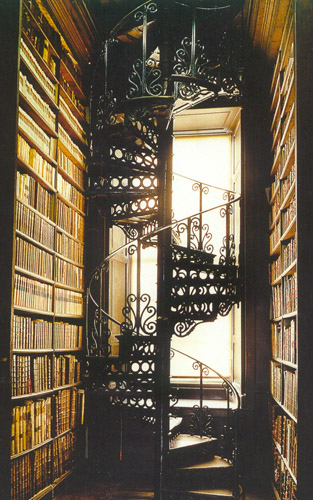
in the Black Pope's Study.
Part I, The Path of the Druids by Zeus
Part II, Catholicism with a small c by Mark
Part II.V, Mark's Catholicism continued
Part III, The Baha'i Faith by Rachel
Part IV, A more catechismal Catholicism, by Tessa
Part V, Curanderismo, by Jim
Part VI, The Latter Day Saints (LDS for short), by Clay
Part VI.V, LDS continued
Part VII, Wicca, by Mandy
Part VIII, Buddhism, by the Reverend
Part IX, Islam, as seen by Wahab
Part IX.V, Wahab's Islam continued
Part X, Another view of Islam, by Ayesha
Part XI, Germanic Reconstructionist Paganism, by Christin
If you would like to add your faith to our little survey of world religions, check out the original list of questions here. The Ministry welcomes all faiths! If you are a Jew, Hindu, Jain, Seventh Day Adventist, Jehovah's Witness, Quaker, Mennonite, Peyotist, Metheist, Satanist - or anything else - please drop me an Email at the address listed in my profile.
Go in Peace.


 Posts
Posts

